Old Photo to Video AI: A Family Review Checklist Before You Share
Before you share an old photo to video AI clip, keep an untouched copy of the photograph, ask the people closest to the memory whether the animation feels appropriate, and make it clear that the movement is newly generated. This is the key family review step after a technical photo-to-video workflow: decide whether a gentle animation belongs in a private conversation, a family archive, or nowhere at all. It is not a way to recover undocumented speech, feelings, or events.
This companion is about the sharing decision, not another restoration tutorial. For scanning, repair, and restrained motion, start with Turn Old Photos Into Video With AI. The source guide was last updated July 5, 2026; this page addresses the separate question that follows a render: what should a family check before the clip leaves the people who know its context?
Start by preserving the photograph, not replacing it
An animated derivative is not a better version of the original photo. It is a new interpretation made from that photo and a model’s inferences. Keep the scan, the restoration file, and the generated clip as separate files with understandable names. Do not overwrite the source image or relabel the animation as if it were a recovered recording.
The U.S. National Archives’ digitizing guidance makes the preservation point plainly: retain originals after digitization because digital files can be lost. For a family collection, that also gives later relatives a way to see what was actually captured before any restoration or animation.
Use a simple folder or album structure:
| File | Example label | Why keep it |
|---|---|---|
| Original or master scan | 1968-grandma-porch-original.tif |
Preserves the historical object or closest digital copy |
| Restored still | 1968-grandma-porch-restored.jpg |
Shows what was repaired or adjusted |
| Generated motion test | 1968-grandma-porch-ai-motion-v1.mp4 |
Makes the derivative and its version clear |
| Sharing note | 1968-grandma-porch-review-notes.txt |
Records who reviewed it and where it may be shared |
The labels do not need to be perfect metadata. They need to avoid a future mix-up between a documented photograph and an animation made years later.
Ask who should have a say
No tool can decide what is respectful for a family. The relevant reviewers may be the person who owns the photo, close relatives, a family historian, or the people who will be portrayed as speaking for a shared memory. The answer may be different when a person is living, when the photo concerns a death or a sensitive event, or when the intended audience includes people who did not know the subject.
Start with a short, specific invitation rather than a vague “Is this okay?” For example: “I made a five-second AI animation from this 1968 porch photo. It adds a small smile and camera movement that were not in the original. Would you be comfortable with it staying in our private family album? Is there anything you would want changed or not shared?”
That wording names the alteration and proposes a scope. It also gives someone room to say no. Silence is not a reliable approval process for a recognizable person or a meaningful family memory.
Review meaning as well as visual quality
Technical defects matter, but a smooth result can still imply something the original never showed. Watch the full clip with a reviewer who knows the picture’s context. Stop whenever the model adds expression, gesture, relationship, or mood that would change how a reasonable relative understands the memory.
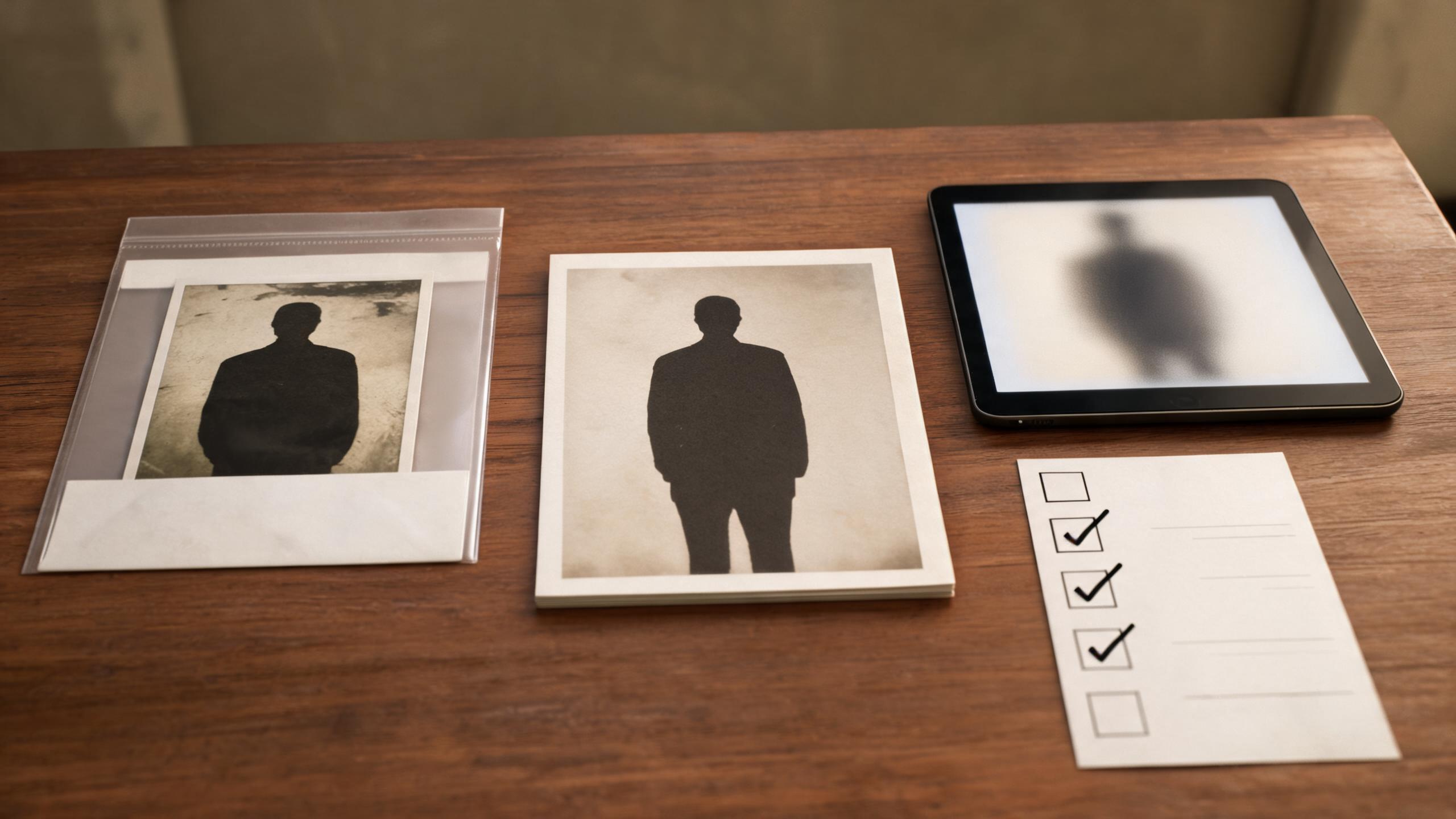
Conceptual review visual. It shows a cautious review process, not a historical reconstruction or a ClipTrend interface.
Use this checklist before sharing:
- Original retained: Is the unaltered scan stored separately and easy to find?
- People identified carefully: Have you checked names, dates, and locations against what the family actually knows, rather than letting an animation suggest missing facts?
- No invented testimony: Does the clip avoid speech, lip-sync, or gestures that could be mistaken for the person’s real words or feelings?
- Appropriate motion: Is the movement subtle enough that it does not turn a solemn or private image into a performance?
- Right reviewers: Has the owner or an appropriate close relative had a real chance to comment or decline?
- Clear label: Will viewers know the clip was AI-generated or materially altered from a still photo?
- Audience limit: Is private sharing, a small family group, or no sharing a better fit than a public feed?
There is no score that makes a clip automatically acceptable. One material concern is enough to stop. A good review process makes a “no” easy and does not treat more generation as the answer to a discomfort problem.
Match the destination to the sensitivity of the image
Private sharing and public posting are different decisions. A family chat may include people who understand the photo’s context; a public post can be copied, re-captioned, and seen by strangers who do not. Start with the narrowest destination that serves the purpose.
| Destination | Better when | Extra check |
|---|---|---|
| Private family album | The goal is remembrance among people who know the context | Explain that motion was generated and retain the original nearby |
| Small group message | A few relatives want to discuss or approve the result | Ask whether anyone wants the clip removed or revised |
| Memorial or event screen | Organizers and close family agree on the treatment | Confirm wording, disclosure, and the final edit in advance |
| Public social post | The family has an affirmative reason and agreement to share | Add plain context, avoid claims, and consider whether the post invites harmful attention |
If the photo depicts a minor, a painful period, a contested family story, or a person whose wishes are unknown, private review becomes more important—not less. Do not use an AI animation to settle a historical disagreement or to supply a reaction that was never recorded.
Label the derivative without overstating the label
A simple caption such as “AI-animated from a 1968 family photograph; the original is preserved separately” gives viewers honest context. It does not grant permission, prove every detail in the photo, or guarantee that the clip will retain a label after reposting. Keep the original and the written context with the family record as well.
Where available, provenance information can complement that record. The C2PA Content Credentials explainer notes a useful limit: provenance records can make certain creation and edit information tamper-evident, but they do not decide whether an image or video is factually true. Treat a provenance record as supporting context, not as permission from relatives or proof of history.
For the technical first pass, use the linked old-photo animation workflow to start with a clean scan and one restrained motion. If the goal is a general approved still rather than an old family photograph, ClipTrend’s Image to Video workflow is the more general starting point. The family review still applies whenever the image carries personal meaning.
FAQ
Is it okay to animate an old family photo with AI?
It depends on the people, history, and intended audience. Preserve the original, be explicit about what was generated, invite appropriate family reviewers, and choose the smallest sharing audience that fits the purpose. Do not use an animation to imply events, speech, or feelings that were not documented.
Should I ask permission before sharing the clip?
When the photo is recognizable or emotionally important, ask the owner and the people closest to the memory before sharing beyond a private working review. An affirmative discussion is better evidence of respect than assuming silence means yes.
How should I label an AI-animated old photo?
Use plain language: for example, “AI-animated from a family photograph; motion was generated from the still.” Keep the original scan and a short note with the file so later viewers can distinguish the source from the derivative.
What if a relative dislikes the animation?
Stop sharing it. Keep the original photograph intact, listen to the concern, and do not try to persuade someone that a smoother or more dramatic regeneration resolves a question of dignity or consent.
Let the original lead the decision
An old photo to video AI tool can create a brief, moving interpretation. The family still decides whether that interpretation belongs in the story. Preserve the source, name the alteration, make room for a no, and let private context—not a viral-looking render—set the sharing boundary.