Classic Halloween Characters: Origins and Signature Looks
Classic Halloween characters include witches, vampires, werewolves, ghosts, skeletons, zombies, and mummies. You can choose these and other generic looks on ClipTrend.ai's Halloween Characters page to see yourself as a character. The quickest way to distinguish them is by their visual cues: a witch's pointed hat, a vampire's fangs and collar, a werewolf's fur and ears, or a mummy's linen wrappings. Their stories come from different traditions, so they do not all share one Halloween origin.
Updated October 14, 2026 · By the ClipTrend.ai Editorial Team
Disclosure: ClipTrend.ai offers the portrait tool linked here. The cover is an illustrated character reference, not a set of photos produced by the studio.
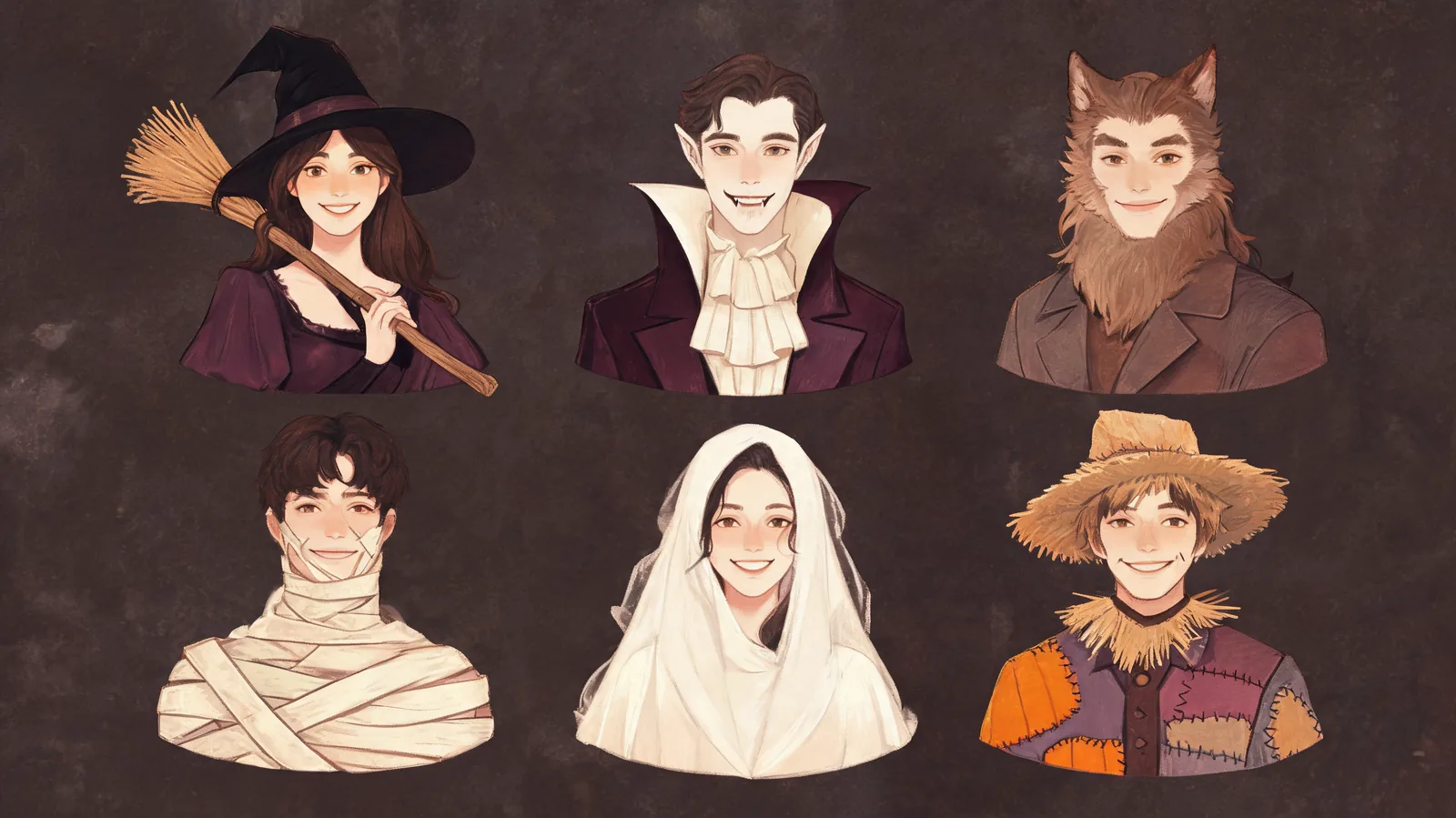
Witches, vampires, and werewolves: three different legends
These familiar choices each have a different defining idea: magic, the undead, or a person taking animal form. Their current costume details are useful visual shorthand, but they should not be mistaken for a single historically accurate outfit.
Witch: magic, a pointed hat, and a broom
Background: The costume draws on beliefs about witchcraft and later folk stories, art, and popular culture.
Signature look: A pointed hat, dark clothing, broom, and cauldron make the theme readable. HISTORY's account of witch costume imagery explains that the familiar hat has several proposed roots, rather than one settled origin.
The studio's Witch preset uses a tall black hat, long dark dress, purple shawl, and candlelit cottage. Select Witch in the character gallery for that direction. It works well when you want a recognizable person with a strong silhouette instead of fur or skeletal makeup. These are fantasy costume cues, not a description of modern religious practitioners.
Vampire: an undead figure with fangs
Background: Vampire stories concern beings that feed on the living; their legends predate the modern formal costume, as HISTORY's vampire overview explains.
Signature look: Small fangs, a high collar, dark clothing, and red accents suggest the elegant version of the character.
Choose Vampire in the gallery for a black cape with red lining, smoky eyes, dark red lips, and a candlelit castle scene. The face and formal outfit carry the idea together. If you prefer a coordinated pair, the vampire couple costume ideas guide explores variations on that theme.
Werewolf: a person with wolf-like features
Background: Werewolf legends describe a person changing into a wolf or wolf-like being. The University of New Mexico's Tony Hillerman Portal summarizes this folklore concept.
Signature look: Fur, pointed ears, animal-like eyes, and a moonlit setting distinguish the werewolf from a vampire.
Select Werewolf, the page's default, for furry sideburns, amber eyes, and a torn flannel shirt in a pine forest. Its demonstration uses a man from a living-room selfie and shows the character portrait beside a short clip. The transformation is centered on creature details while keeping a human face visible.
Ghosts, skeletons, zombies, and mummies: four ways to show the uncanny
These characters are sometimes grouped together as “undead,” but that label hides their differences. A ghost is a spirit; a skeleton is a visual image of bones; a zombie is a reanimated figure; a mummy begins with a preserved body. Their portrait motifs reflect those separate ideas.
Ghost: a spirit in pale, flowing clothes
Background: Ghost stories imagine the presence or return of the dead and appear in many storytelling traditions.
Signature look: Pale flowing fabric, mist, and an eerie glow communicate the theme without an elaborate prop.
The Ghost preset uses tattered white Victorian-style clothing and a moonlit abandoned manor. It keeps the face visible rather than relying on a sheet that covers the head. Choose it for a soft, spectral atmosphere. The clothing is the preset's artistic interpretation, not a universal description of ghosts in folklore.
Skeleton: bones as a visual motif
Background: The character comes from the human skeleton and its association with death, rather than a single legend.
Signature look: Black-and-white skull makeup and white bone shapes on dark clothing.
Select Skeleton for skull face paint and a bone-print bodysuit in a foggy street scene. The defining detail is the contrast between dark eye sockets and pale bone shapes. For variations that emphasize the face, the skeleton face-paint ideas guide compares simpler and more detailed designs.
Zombie: a reanimated figure
Background: Zombie traditions have important roots in Haitian belief, while the familiar Halloween depiction is shaped by later entertainment. HISTORY's zombie history discusses that distinction.
Signature look: Gray-green makeup, dark eye circles, and distressed everyday clothing.
Choose Zombie for that movie-style appearance in a misty abandoned town. The preset calls for a blood-free look. It is a fictional costume treatment; it does not represent Haitian religion or explain the full cultural history behind the word.
Mummy: linen wrapped around an uncovered face
Background: The costume borrows from preserved, wrapped bodies, especially the popular image of ancient Egyptian mummification.
Signature look: Aged linen layers, dusty makeup, and gold-colored accessories.
Choose Mummy for a torchlit tomb setting, with wrappings around the body and hair while the face stays uncovered. The portrait borrows visual motifs for a costume; it is not an archaeological reconstruction or a claim that preserved bodies returned to life.
Four more gallery choices, plus a distinct cultural tradition
As of October 14, 2026, the solo gallery also contains Pirate, Devil, Fallen angel, Scarecrow, and Day of the Dead. The first four widen the selection beyond familiar monsters:
| Gallery choice | Background in one line | Signature direction |
|---|---|---|
| Pirate | A theatrical character based on seafaring raiders. | Tricorn hat, captain's coat, sash, and a foggy ghost-ship deck. |
| Devil | A costume drawing on religious and folkloric imagery of evil. | Small red horns, red-and-black clothing, and an ember-colored backdrop. |
| Fallen angel | A fantasy interpretation of the religious idea of an angel's fall. | White feathered wings, silver details, and a misty cathedral. |
| Scarecrow | A figure derived from field decoys used to discourage birds. | Straw details, patched clothing, and an autumn field atmosphere. |
Tap the matching label in the same character gallery to select one. Fallen angel is the name of the preset, even though its pale wings and soft lighting give it a gentler appearance than the name may suggest.
Day of the Dead needs separate context. Its gallery look uses decorative skull makeup and floral details. Día de los Muertos is a Mexican tradition of remembering and honoring the dead, with Indigenous and Catholic influences; it should not be described as another Halloween monster. The Smithsonian American Art Museum's account of the tradition explains its meaning and development. Select this look with that context in mind, and avoid presenting a decorative AI portrait as an authentic ceremonial design.
Choose by the feature you want people to recognize
For a tiny avatar, a hat, ears, or strongly contrasting face paint can remain readable after cropping. For a larger portrait, the setting has more room to contribute: castle candles for vampire, pines for werewolf, or linen and torchlight for mummy.
You can make any of these as a photo first. The generator uses a consented selfie and offers an optional five-second vertical video after the portrait. For the practical steps and photo advice, follow the Halloween character photo tutorial.
This video explores the history behind familiar witch, vampire, and ghost costumes.
FAQ
Are all classic Halloween characters monsters?
No. Witches, pirates, and scarecrows can be playful or mysterious, and an angel is not inherently a monster. The gallery groups recognizable seasonal costume themes rather than one category of creature.
What is the difference between a vampire and a werewolf?
A vampire is an undead, blood-feeding figure in legend; a werewolf is a person who takes wolf-like form. In a portrait, fangs and a formal collar suggest vampire, while fur and pointed ears suggest werewolf.
Is Day of the Dead another name for Halloween?
No. Día de los Muertos is a distinct tradition honoring the dead. Its decorative skull imagery deserves that context even when it appears in a seasonal portrait gallery.
Do classic character costumes have one original design?
Usually not. Folklore, art, theater, and later entertainment have changed their appearances. A familiar costume silhouette is useful shorthand, but it does not establish one authentic historical version.
Find your character in the gallery
Choose the motif you like: magic, fur, linen, bones, or mist. Explore the Halloween Characters gallery and select a classic look for your own portrait.