Skeleton Face Paint Ideas: 7 Styles to Preview and Paint
For easy skeleton face paint ideas, choose a half skull or a simple cheek-and-jaw design; for a bold portrait, choose a full black-and-white skull. Glam shading, colored accents and fine cracks add detail but demand more brush control. You can explore a skull-painted portrait of yourself in ClipTrend.ai's AI Skeleton studio before painting. Its default is a full skull look; the seven ideas below are makeup directions, not seven built-in presets.
Updated October 12, 2026 · By the ClipTrend.ai Editorial Team
Disclosure: This guide is published by ClipTrend.ai. The cover shows illustrated makeup planning charts, not results from the studio. Difficulty ratings are editorial comparisons, not measured application times.
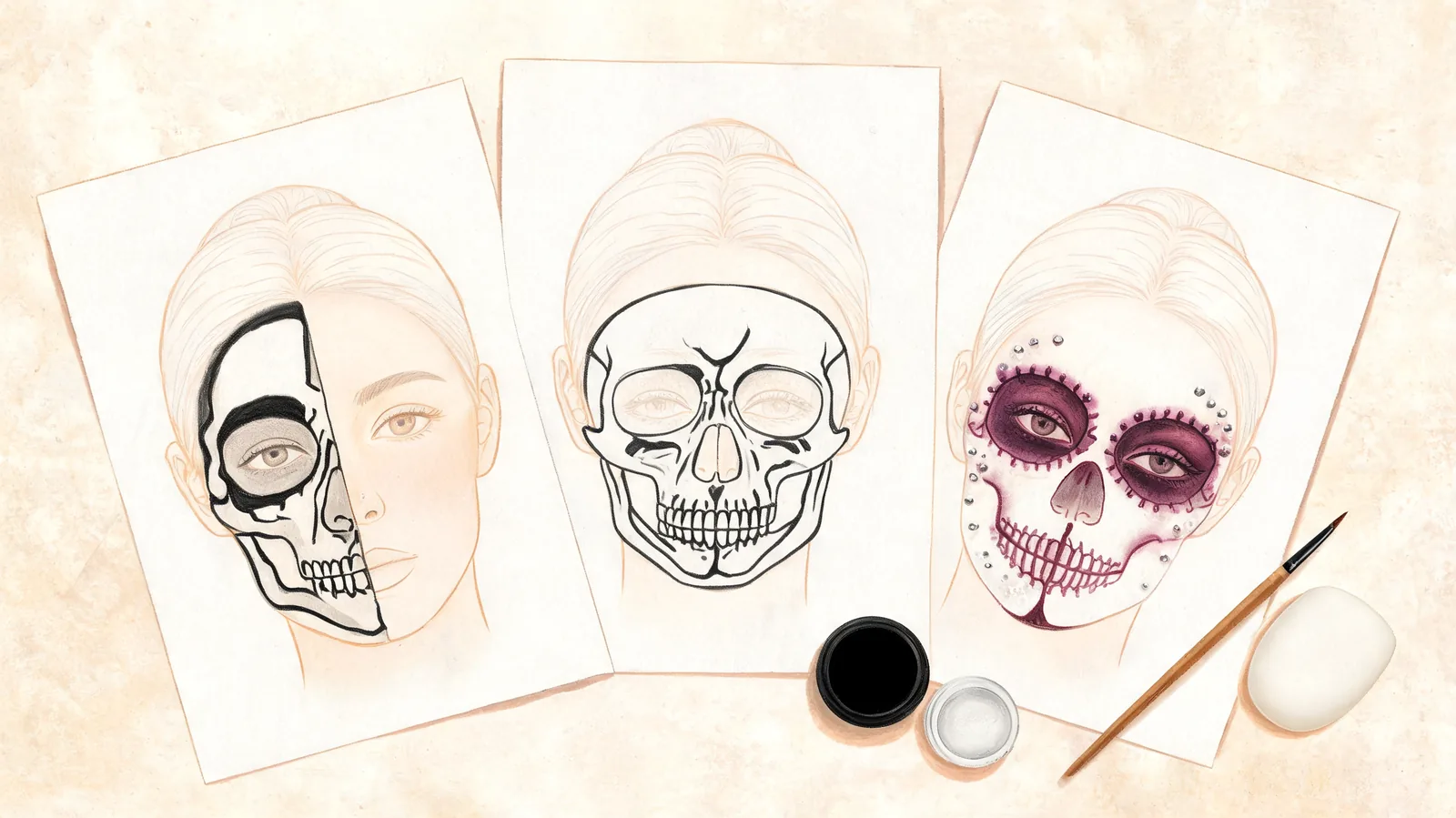
Choose by coverage before choosing the details
The first decision is how much of your face you want to paint. A small design leaves more of your everyday expression visible and gives you fewer edges to finish. A full white base offers more room for a dramatic skull, but adds work around the hairline, jaw and mouth.
Difficulty below describes the relative amount of coverage, symmetry and fine line work. A half skull can still be demanding if you add elaborate teeth; a full skull can stay fairly simple if you use large clean shapes. Pick the amount of detail you can apply comfortably rather than copying every mark in a reference.
| Style | Relative difficulty | Main supplies | Choose it when |
|---|---|---|---|
| Half skull | Moderate | Black and white cosmetic paint, sponge, fine brush | You want a clear contrast with less coverage |
| Classic full skull | Moderate | White base, black paint, broad and fine brushes | You want face paint to lead the costume |
| Cheek-and-jaw skull | Lower | Black paint, optional white, fine brush | You prefer a smaller design away from the eyes |
| Glam skeleton | Higher | Skull paint plus suitable cosmetic shadow | You enjoy blending and a polished finish |
| Sugar-skull-inspired hybrid | Higher | White, black and colored cosmetic paints, detail brush | You want decorative color with cultural context |
| Graphic cracked skull | Higher | Black and white paint, very fine brush | You prefer precise line work over blending |
| Color-accent skull | Moderate | Black and white paint plus one cosmetic accent color | You want the makeup to echo an outfit |
Seven skeleton face paint ideas
1. Half skull with a clean center line
Paint one side as a skull and leave the other side bare or in your usual makeup. Keep the divide simple: a line down the forehead and nose gives the two halves a deliberate boundary. Restrict the painted teeth to the skull side so the contrast remains easy to read.
This is a good choice when you like the skull theme but want less white-base coverage. Its main challenge is making the boundary tidy, especially near the nose and mouth. Begin with a broad cheek shape and a few tooth marks; add smaller details only after the large shapes look balanced.
Pair it with a plain black top if the face is meant to be the focus. A busy bone-print outfit can work too, but it changes the balance from a makeup-led look to a full costume.
2. Classic full black-and-white skull
A pale base, dark nose shape, cheek hollows and painted teeth create the familiar full skull direction. Keep the dark areas distinct so the design reads clearly from a normal viewing distance. Tiny details are less important than a coherent outline.
The extra coverage makes this more demanding than a small jaw design. Plan the edges at the hairline and jaw, and check the left and right cheek shapes before refining the teeth. Use only products labeled for their intended placement; a dark socket shape does not mean every black face paint is suitable near the eyes.
This is the closest of these ideas to the studio's default Skeleton makeup. The digital default also includes a bone-print bodysuit and foggy street scene, which are separate from the real paint design you choose.
3. Cheek-and-jaw skull with an unpainted upper face
Use the lower face to suggest a skull: a dark cheek hollow, a short row of tooth markings and a light jaw outline can carry the theme. Leave the forehead and eye area out of the design.
This option has fewer painted areas and does not depend on matching two large eye shapes. It is useful when you want a restrained costume or already have a hairstyle and eye makeup you want to keep. The mouth still moves, so check how the lines look when you smile instead of judging only a neutral expression.
Keep the tooth marks short and clearly painted. There is no need to add wounds, exposed bone or other effects for the design to read as a skeleton.
4. Glam skeleton with soft plum shading
Combine a skull nose and cheek shape with blended plum or charcoal shading. Keep the painted tooth lines crisp so the face does not become one large smoky area. A few small cosmetic accents on the outer cheek can add interest without filling every space.
The challenge here is combining soft transitions with sharp graphic marks. Plan where the blending stops before adding the teeth. Use cosmetics suited to each area and avoid extending a face-paint product toward the eyes just because its color matches your shadow.
This suits someone who already enjoys makeup blending. If that technique feels unfamiliar, choose the color-accent version below instead: one clear color shape is easier to control than several layered gradients.
5. Sugar-skull-inspired hybrid with decorative color
Combine simple skull markings with floral shapes, dots or colored cheek decoration. Decide on a small palette first, such as teal and marigold alongside black and white. Limiting the colors helps the ornament feel intentional rather than crowded.
The cultural context matters. Decorated calaveras belong to Día de los Muertos traditions that honor the dead; they are not simply another name for a Halloween skeleton. The Smithsonian's explanation of Día de los Muertos gives useful background. Describe a decorative hybrid accurately and learn about the tradition rather than presenting your own Halloween variation as an authentic ceremonial design.
The fine decoration makes this a more involved choice. Start with a few large motifs instead of covering the whole face with small dots and swirls.
6. Graphic cracked skull without wound effects
Add a small branching painted crack to the forehead or cheek of a simple skull. Treat it as a flat graphic line on skin, with no injury or gore. One controlled cluster can give the design a focal point.
Use a fine brush and leave space between branches. If cracks cross every cheek contour and tooth marking, the face becomes harder to read. Choose one area for the effect and keep the rest of the skull relatively clean.
This is a higher-detail option because uneven line weight is easy to notice. Practicing the branching pattern on paper can help you decide its shape before reaching for cosmetic paint.
7. Color-accent skull matched to your outfit
Keep most of the design black and white, then add one colored section: a violet temple, a teal cheek edge or a narrow warm-orange outline. Repeat a color already present in your outfit to connect the face and clothing.
One accent is enough to make the look feel personal. You do not need a rainbow palette or special glow effects. A clean edge between the accent and black shading will usually do more for the finish than another layer of decoration.
For two people, share the accent color while adapting the shapes to each face. This creates a coordinated pair without requiring identical makeup or equal amounts of coverage.
See a real skull makeup demonstration
This tutorial shows makeup artist Tom Buckle demonstrating a simple skull makeup look.
Use a demonstration to understand the order and size of the painted shapes, then choose the coverage and detail level that fit your own plan. A video reference is most helpful when you pause at the large shapes before focusing on the smallest lines.
Preview a direction on your own face
As of October 12, 2026, ClipTrend.ai's Skeleton page offers a photo-first costume studio. Upload one clear, front-facing selfie in 1 Person mode; the Skeleton preset is already selected. Generate Image creates a portrait with black-and-white skull paint, a bone-print bodysuit and a foggy night street. The photo estimate is about a minute, not a guaranteed completion time.
The studio aims to preserve recognizable features and does not swap faces. Upload yourself or someone who agreed to be pictured. For a shared portrait, use 2 People and add one separate selfie for each consenting person.
The shared studio has 12 solo and 12 couple presets, plus costume-photo upload and costume descriptions. To explore one of the ideas above, you can describe a fully clothed costume direction with the makeup detail you want. A half skull or plum-accent request is custom guidance, not a named Skeleton preset, and the result may not reproduce every line exactly.
Save a portrait you like as a reference, then adapt its proportions for real paint. The preview does not test cosmetics, skin response, clothing fit or how the design holds up during an evening. If you want the full upload and review sequence, follow the AI Skeleton photo tutorial.
After the still image, an optional five-second vertical video is available: Standard 480p continues to Image to Video, while HD 768p is labeled with sound. The still photograph remains the easier format for studying paint placement.
Before using real face paint
Choose cosmetics intended for skin and follow their labels, including eye-area restrictions. Remove makeup as directed when you are finished. The FDA's novelty makeup guidance also recommends checking a small amount of an unfamiliar product on the arm ahead of time for a possible reaction. A digital portrait cannot establish that a real product is suitable for you.
Keep the supplies modest: the right cosmetic colors, an appropriate sponge, one broader brush and a detail brush. Buy additional colors only after you have chosen a design that uses them. Check the actual product instructions rather than assuming supplies are interchangeable.
FAQ
Which skeleton face paint idea is easiest for a beginner?
A simple cheek-and-jaw design has less coverage and fewer large shapes to balance. A half skull is another manageable starting point if you keep the center boundary clean and avoid intricate teeth or shading.
Can skeleton makeup work without a white base?
Yes. A smaller black cheek-and-jaw motif can suggest a skull while leaving much of the skin unpainted. White paint adds contrast, but it is not necessary for every design in this guide.
How can two people coordinate different skull designs?
Choose a shared palette or one accent color, then adjust coverage separately. One person can wear a half skull while the other uses a full skull. Consistent colors can tie the pair together without copying every mark.
Are these seven styles all available as Skeleton presets?
No. They are editorial makeup ideas. The page's default Skeleton look is full black-and-white skull paint with a bone-print outfit. You can request custom directions through a description or costume reference, with no guarantee of exact reproduction.
Pick your paint direction
Choose one style you would enjoy painting, then explore a visual reference in ClipTrend.ai's AI Skeleton studio. Keep the design simple enough to adapt with the real cosmetics and brush skills you have.