Alors on Danse Trend Explained: The Keyboard Duo
The Alors on Danse trend is a remake of a comedy scene featuring Stromae and Jamel Debbouze: one person plays a tiny keyboard while the other becomes an increasingly animated coach beside a laptop. New versions recast that white-studio duo with different faces. ClipTrend's Alors on Danse AI page offers a two-photo version. The scene comes from the 2010 Made in Jamel sketch, and its soundtrack is Stromae's “Alors on danse.”
Explained as of October 14, 2026 · By the ClipTrend.ai Editorial Team
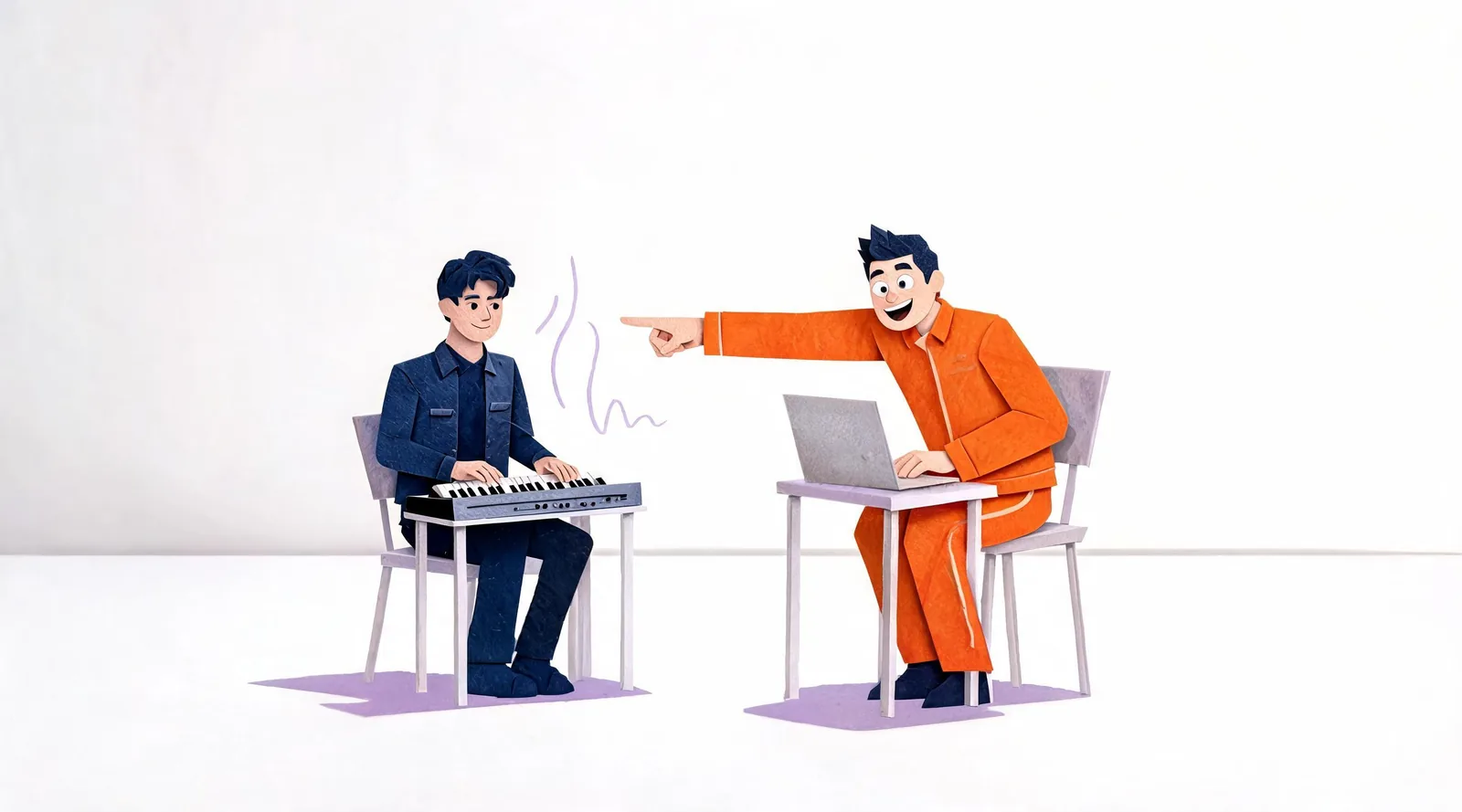
ClipTrend makes the fan tool mentioned below. It is unofficial and not affiliated with Stromae. The cover illustrates the two contrasting parts; it is not footage or a product result.
Recognize the scene before identifying the faces
Look for the setting and performance, rather than a particular pair of people. There is a bare white studio, a very small keyboard and a laptop. One character attends to the keyboard; the other behaves as though they are directing a major musical breakthrough.
The coach points, gestures and becomes the focus of a camera-facing reaction. The keyboard player provides a steadier counterpart. That mismatch is the comic pattern: an ordinary-looking musical task attracts an outsized response.
A remake may show friends, a couple, animals or drawn characters in those positions. If the faces are different but the keyboard, coaching and studio timing remain recognizable, you are looking at a recasting of this scene. The identity of the pair is the variable, while the performance is the shared reference.
That distinction helps when someone labels a post simply “Alors on danse.” The phrase can refer to the song, other dance clips using it, or this specific keyboard-and-coach scene. The tiny keyboard and emphatic coach are the clues for the studio version.
The source is a comedy sketch, not a songwriting documentary
Stromae is the musician associated with the song. Jamel Debbouze is the comedian performing the coaching joke. In the sketch, Jamel pretends to help Stromae create the hit. The apparent music lesson is a comic setup; it should not be retold as evidence that Jamel wrote the song.
The sketch belongs to Made in Jamel, released in 2010. Fnac's Made in Jamel DVD listing records the collection's release as December 1, 2010. Jamel TV identifies the Stromae scene as part of that collection.
The music has its own history. Fnac's Stromae profile connects his breakthrough to the 2010 debut album Cheese and “Alors on danse”. The sketch is built around that existing musical identity; the current remakes do not introduce a new Stromae song.
Keep those layers separate when explaining the joke to a friend: the artist and song, the comedian's fictional coaching scene, and the newer versions that substitute another duo. A face replacement belongs to the third layer. It does not turn the people shown into the original performers.
What is returning in the current remakes?
As of October 14, 2026, the recognizable studio scene is circulating again through AI recastings shared as short social clips, including TikTok and Reels remakes. The renewed variation is the cast: people can put a different pair into familiar movements without filming the white-studio performance themselves.
There is no need to invent a single explanation for its spread. A clip can be recognizable, easy to recast and amusing to a particular group without those observations proving which post started a resurgence or why an algorithm promoted it. Dates attached to recent posts also do not date the original sketch.
The useful explanation for a viewer is narrower. Each remake asks, “What would this pair look like in these roles?” A family version and a character version can share the same scene while making very different jokes. The context comes from the relationship between the two subjects.
Treat any claim that one particular upload started the entire trend cautiously unless its chronology is documented. You can understand the format and enjoy a version without attaching a first-post story to it.
Why the two parts are not interchangeable within a clip
The keyboard role is comparatively contained. The coach role is conspicuous: pointing, reacting and leaning toward the camera. Calling both people “the dancers” misses the contrast that distinguishes this sketch from a synchronized dance routine.
In a remake, casting changes how the audience reads those behaviors. A normally reserved person as coach creates a reversal. Two familiar drawn characters may bring an existing rivalry into the scene. An animal in the coach position can make the exaggerated reaction the center of the joke.
These are possible creative readings, not promises about a particular generated result. A pair can be recognizable to your friends and completely unfamiliar to everyone else. The best caption gives enough context for the intended audience without explaining every movement.
| Casting choice | Question it answers for the viewer | What stays recognizable |
|---|---|---|
| Reverse a pair's usual personalities | What if the quiet one became the enthusiastic director? | The contrast between keyboard work and big reactions |
| Use two original drawn characters | How would this fictional relationship play out in a studio? | The equipment, timing and coaching role |
| Give a pet the expressive part | What if the animal were the one supervising? | The final camera-facing reaction |
A remake works as a shared joke when the audience can identify both the scene and the casting idea. You do not have to pretend the subjects can play an instrument or actually performed together.
What ClipTrend's version changes
The live tool accepts two photos and assigns them to the two parts. Photo 1 is the keyboard player on the left. Photo 2 is the coach on the right. Swapping the uploads swaps the roles, so the cast order is a creative choice rather than a random assignment.
As of October 14, 2026, the result is a ten-second, landscape 720P video with the original song. The white studio and its performance provide the common frame. The page supports friends, couples, a parent and child, pets and drawn characters, with clear source images.
Its own demonstration shows two uploaded people in the studio result. Watch that on the feature page to understand the offered output. It does not establish that any other pair you imagine has already been generated, nor that every face or illustrated style will look equally convincing.
Allow approximately ten minutes after starting. You can leave the page and retrieve the completed video in My Creations. Those are the tool's current workflow details, rather than attributes of every remake you encounter online.
For photo selection, upload order and downloading, use the two-photo studio-duo tutorial. Here, the key point is that you are choosing the cast of an existing scene.
Read a remake as an imagined performance
A realistic face does not make the clip a real recording. When sharing your own version, describe it as an AI remake, and only use photographs of people who agreed to be included. Permission to try a private joke and permission to publish it are separate decisions.
The song and recognizable performance remain part of the reference. Their presence does not imply that Stromae or Jamel endorses the new cast or the service used to make it. ClipTrend's tool is an unofficial fan tool, unaffiliated with Stromae.
Before posting, watch the whole clip and ask whether the joke could mislead someone about the people shown. A short, clear caption is often enough to explain the imagined casting. Keep both performers visible when adapting the landscape frame for a vertical feed.
FAQ
Is the studio scene from a new Stromae music video?
No. The keyboard-and-coach scene comes from the 2010 Made in Jamel comedy sketch featuring Stromae and Jamel Debbouze. Recent face-recast versions are remakes of that scene.
Who are the keyboard player and coach in the source sketch?
Stromae supplies the musician role and Jamel Debbouze performs the exaggerated coaching role. The comedy pretends that Jamel is helping create the song; it is not a factual account of its authorship.
Is the audio a different song made for the trend?
The reference is Stromae's Alors on danse. ClipTrend's current studio-duo effect includes the original song in its ten-second output, rather than asking you to record new music.
Is Alors on Danse AI an official Stromae service?
No. ClipTrend's Alors on Danse AI is an unofficial fan tool and is not affiliated with Stromae. A remake should not be presented as an endorsement by the original performers.
Recast the scene
Want to choose a new cast for the scene? Visit Alors on Danse AI and decide which consenting subject belongs at the keyboard and which should coach.