Best Haircuts for a Square Face (Men): 4 Cuts Compared
For men with a square face, a textured crop, natural side part, modest quiff or crew cut with tidy sides makes a useful starting shortlist. Texture adds movement, a side part breaks up symmetry, a quiff adds height, and a crew cut leaves the jaw visible with less styling. Pick the effect you want, then preview hairstyle suggestions on your own photo before discussing the choice with a barber.
October 14, 2026 · Editorial guide
Disclosure: This site offers the linked photo preview tool. The cover illustrates haircut shapes; it is not a customer's result. The advice below concerns styling preferences, not professional or medical assessments.
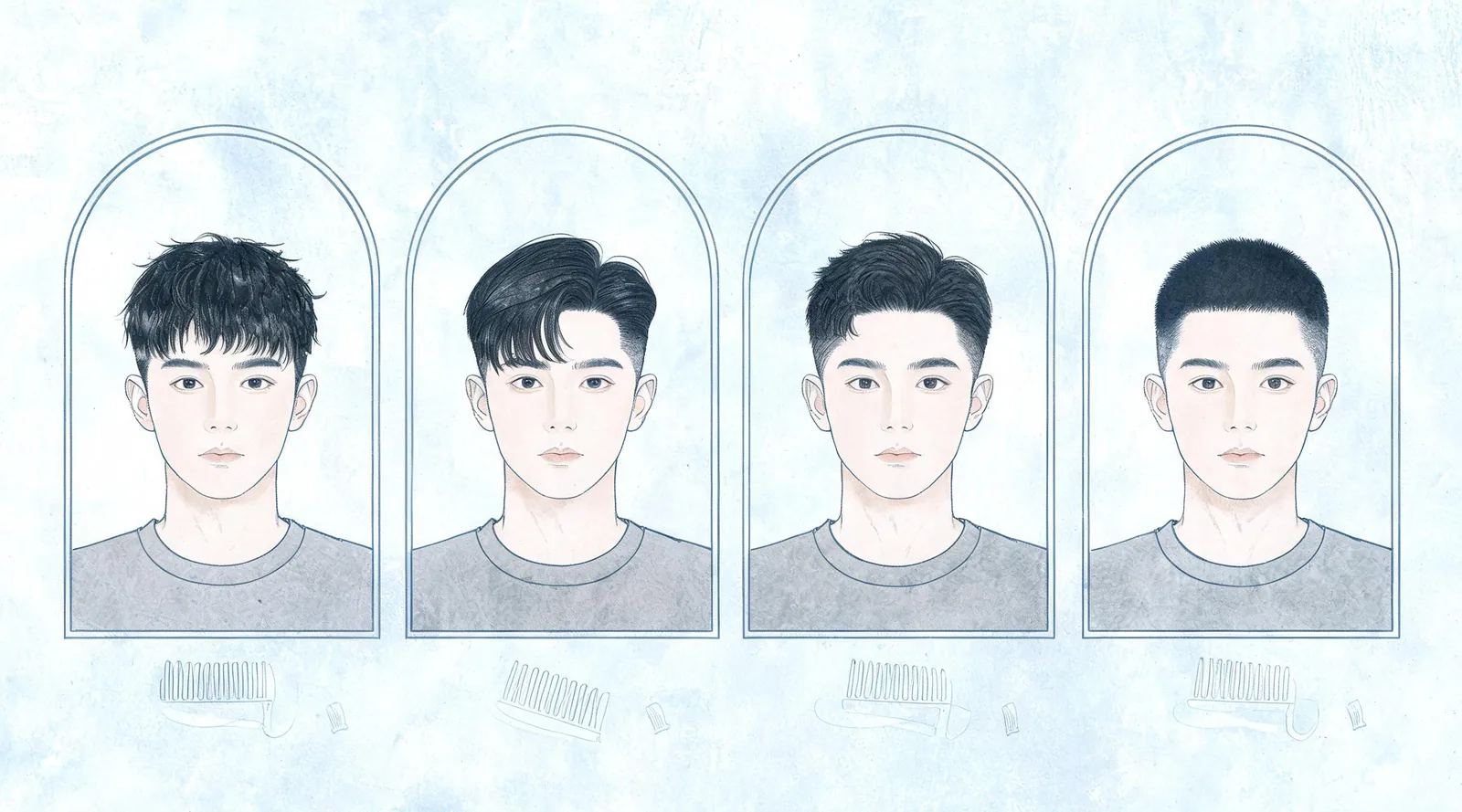
Which of the four should you choose?
Use your morning routine and preferred outline to narrow the shortlist. None of these cuts is compulsory for a square face, and there is no universally best one. The same style name can cover different lengths and finishes.
| Cut | Usual visual effect | A useful choice when | Check before committing |
|---|---|---|---|
| Textured crop | A broken top outline adds movement around a strong jaw | You want a compact shape without tall styling | How the fringe falls and how much forehead it covers |
| Natural side part | A diagonal sweep interrupts a very symmetrical outline | You prefer a neat cut with some length to comb | Whether your growth pattern supports the part |
| Modest quiff | Front lift adds vertical emphasis | You enjoy arranging the front and want an open forehead | Whether the height suits your face length and density |
| Crew cut | Short length exposes the face and jaw | You want little daily styling and like a defined outline | How much scalp, hairline and head shape will show |
A softer-looking result usually starts with a less rigid top and some side weight. If you enjoy a sharper finish, a shorter cut can emphasize your jaw. Decide that preference before debating the exact fade.
Textured crop: movement without a tall front
A textured crop keeps the top fairly compact, with an irregular finish rather than a flat horizontal surface. That variation can soften the outline above an angular jaw. The fringe can sit forward or be moved slightly to one side, depending on the cut and your hair.
Ask the barber how much fringe to keep. A very straight, heavy fringe can add another hard line across the face; a lighter edge produces a different impression. Neither is automatically wrong, but the choice should be deliberate.
For example, if your hair is thick and falls forward, a compact crop may feel more realistic than a lifted style you would have to rebuild every morning. Tell the barber how it behaves when dry and unstyled. Texture should be adapted to your density, rather than removing bulk by habit.
Side part: a change in direction
A side part takes the eye across the top of the head. That diagonal movement gives an alternative to a completely centered, symmetrical silhouette. You can keep it relaxed with a natural separation rather than a deeply defined line.
Ask for enough length to follow your existing growth direction, and discuss the side weight. Neat sides do not have to mean skin-short sides. A gradual taper around the ears can leave a gentler transition into the top.
If you have a stubborn cowlick, show it before the haircut starts. A photo of a side part cannot establish where your hair will reliably separate. Try combing your current hair in the intended direction and tell the barber where it springs back.
Quiff: height you actually want to maintain
A quiff lifts the front away from the forehead. On a broad face, that height can change the apparent balance between width and length. Keep the lift moderate when you want a subtle change, especially if your face is already noticeably long.
The compromise is styling. A picture of a lifted front tells you little about how it sits after a shower, beneath a hat or on a windy commute. Ask the barber to show you the direction to dry it and the minimum routine needed for your hair.
One practical choice is to keep enough length for lift but avoid asking for the tallest version of the reference. You can build more height when you want it. If you dislike arranging your hair, reconsider whether this is the right choice before taking more length off the sides.
Crew cut: a clear outline with less daily arranging
A crew cut is short on top, usually with some graduation rather than exactly one length everywhere. It can look clean and deliberate on a square face because the jaw supplies much of the structure.
The tradeoff is exposure. Your hairline and head shape will be more visible, and the cut offers less hair to move across the forehead. Ask to see how short the proposed length will be before agreeing to it.
Short daily styling does not mean no upkeep. If you want a precise edge throughout the month, discuss a realistic appointment rhythm. A slightly softer taper may grow out differently from very closely cut sides.
Short sides: taper or fade?
A taper gradually reduces length near the edges. A fade creates a more pronounced transition through the sides. Those terms alone do not specify how high the transition goes or how short the shortest section becomes.
For a gentler finish, discuss a low transition and enough remaining hair near the temples. For more contrast, consider shorter sides while keeping the top shape intentional. Avoid choosing a guard number solely because someone online calls it best for square faces.
Compare the front and side views of a haircut reference. A cropped photograph may hide the transition you actually need to explain. Tell your barber whether you want an exposed jaw or a softer outline; that preference gives the fade discussion a purpose.
Check whether your face is square or simply angular
Push your hair away from the forehead and look straight ahead. A square face commonly has similar apparent width through the forehead, cheekbones and jaw, with a more angular jawline. A strong jaw alone does not establish the category. A longer outline may be closer to oblong.
A close-up taken from below can exaggerate the jaw, while a beard can hide its natural edge. Start with a level photograph in even light and ask your barber for their view if you remain unsure.
The distinction matters most when adding height. A tall top can make an already long face appear longer. Use the label as a rough description, then judge the complete silhouette rather than chasing a mathematically exact category.
Compare suggestions on your own face
As of October 14, 2026, the linked photo page accepts one clear front-facing portrait and normally returns a result in about a minute. The output is one image with a face-shape line and a labelled 2x2 grid of four haircut suggestions. It is an image workflow.
The intended comparison keeps your face, clothing and natural hair color unchanged. The page's own square-face demonstration shows a textured pompadour, classic side part, undercut and crew cut. Those are its example suggestions; a new photograph can receive other cuts.
Look for the option whose proportions you like. Do not assume the preview has measured your density, curl shrinkage or styling ability. If you run it again, you receive another sheet. Upload only yourself or someone who has agreed. The photo preparation tutorial explains the upload steps in more detail.
Take a decision to the barber, not just a name
Bring the reference and explain one goal: “I want some movement on top, with a natural part and sides that stay tidy without going very short.” You can then ask whether a crop or side part is the more practical route for your hair.
A stylist's haircut consultation guide recommends bringing pictures, since the same haircut can be described with different names. A working barber's square-face consultation guide also includes density, growth patterns and beard shape in the decision. These are useful considerations beyond the face-shape label.
This video shows named haircut examples for square face shapes.
FAQ
Is a buzz cut a good choice for a square face?
It can be if you like showing the jaw and head shape. A crew cut or short taper leaves more control over the top outline. Ask how much of your hairline and scalp the proposed length will reveal.
Should men with square faces avoid a fringe?
No. Compare a soft, textured edge with a blunt horizontal fringe and choose the effect you prefer. Your growth pattern and the amount of forehead coverage matter more than a blanket ban.
Does curly hair change the shortlist?
It changes how the styles are cut and worn. A curly top can provide movement without copying the exact outline of a straight-haired reference. Ask your barber to adapt the idea to your curl pattern and how you normally dry it.
Can a beard change which haircut looks balanced?
Yes. Beard length and side weight alter the visible lower outline of the face. Discuss the beard and haircut together, particularly if you want to soften an angular jaw.
Is a high fade always wrong for a square face?
No. It may suit someone who wants stronger contrast and a visible jaw. A lower transition is another option when you prefer a softer result. Compare both in relation to the top, rather than judging fade height alone.
Choose the outline you would enjoy wearing, then see hairstyle suggestions on your own face and bring the picture to your next haircut.