Why AI Video Trends Rise and Fade: A Template Lifecycle Guide
An AI video trend is worth testing when the viewer can understand the format in a second, your source can support the motion, and you can add a reason for your version to exist. It is usually not worth chasing once every variation looks interchangeable or the template hides the thing you need people to notice. Start with AI video templates when the structure already fits your idea, then run a small test instead of committing your whole content plan to one trend.
Last updated: July 17, 2026 - about 10 min read
Short-video trends can look like free distribution from the outside. A sound, camera move, character effect, or reveal suddenly appears everywhere, and it is tempting to assume that using the same format will deliver the same attention. In practice, a trend is a shrinking window with different jobs at different moments. Early on, the audience is curious about the format. Later, the audience needs a recognizable variation. At the end, even a technically polished clip can feel late because viewers already know the punchline.
That is why an AI video trend lifecycle is more useful than a list of “viral” effects. The lifecycle helps you decide whether to test, adapt, reuse, or skip a format. It also protects a small team from spending all its generation budget on a template that cannot carry its product, personality, or message.
A trend has stages, not a single score
You do not need a perfect forecast to make a better decision. You need to notice what the format is asking from the viewer right now. A format that is fresh may reward a simple execution. A format that is crowded needs a clearer point of view. A format that is fading may still work in a niche audience, but it should not become the entire publishing strategy.
| Lifecycle stage | What viewers are responding to | Best use of AI video templates | What to avoid | Small test to run |
|---|---|---|---|---|
| Discovery | Surprise, a new motion, or an easy-to-understand transformation | Recreate the structure with one clear personal source | Adding unrelated story elements before the format is understood | One faithful, simple version |
| Expansion | Familiarity plus recognizable variations | Adapt the input, opening, or payoff to a real audience need | Using the same source and ending as every other post | Two different source-led variants |
| Saturation | Speed, novelty, and “have I seen this?” fatigue | Use only if your message changes the format’s meaning | Posting generic copies because the template is available | Compare a trend version with a non-trend version |
| Long tail | A stable niche reference, tutorial, or recurring visual language | Turn it into a repeatable series with a defined audience | Claiming it is still broadly viral | One scheduled, context-specific use |
The stages are not calendar dates. A format can be saturated in one broad feed and still be new to a specific community. The point is to look at the actual audience and your own source material, not a generic “trending” badge.
Start with the first-second question
Before choosing a trend, describe what a person should understand without sound in the first second. For a product, it might be “this is a backpack that becomes the subject of a clean reveal.” For a creator, it might be “this ordinary photo is about to turn into a playful motion clip.” For a service, it might be “this before state has a clear, relevant after state.”
If you cannot state the setup, an AI video trend is unlikely to rescue it. The movement might be impressive, but the viewer has no reason to care. This is the same reason a template can underperform with a weak source image: the format has to begin with an input that is legible before it starts moving.
Use templates when they make that first-second question easier to answer. If the format demands a face but you have a product, or needs an expressive human pose while your source is a small object on a cluttered table, use a different template or an image-to-video workflow with a simpler custom motion.
Find the part you can make specific
Copying a trend exactly is rarely the strongest use of it. Look for one part that can belong to your audience: the source asset, the setting, the problem being solved, the reveal, the caption you add later, or the next clip in a series. You do not need to change all of them. One real point of specificity is enough to turn a generic format into a post with a reason to exist.
For example, a fast reveal template can show a product detail that customers genuinely ask about. A transition format can use an actual before-and-after that is not misleading. A playful character template can become a recurring series only if each source image has a distinct point. The trend supplies the rhythm; your source supplies the relevance.
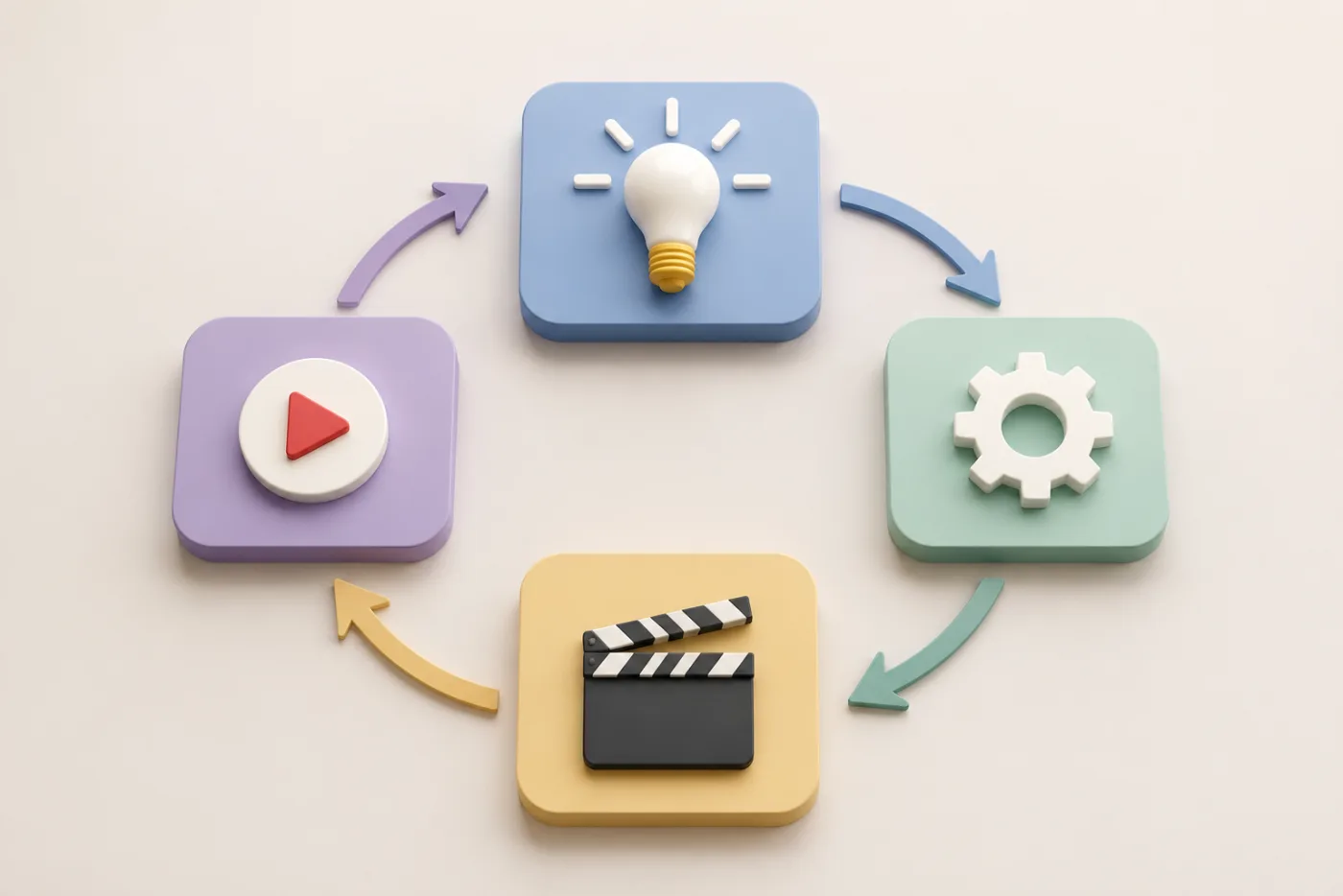
The lifecycle is a decision tool: test a format at the right scale before you build a publishing habit around it.
Give every trend a limited test budget
A small team does not need ten nearly identical renders to learn whether a format fits. Set a test budget before you begin. For most concepts, one simple version and one intentional variation are enough to answer the first question. If both versions make the source clearer and you can name what changed, the idea may deserve a third test. If neither works, stop and choose a different structure.
This is especially useful with AI video templates because it limits random retries. A generated clip can fail because the source is poorly suited to the motion, the crop hides the important detail, the template is too busy, or the premise is not legible. Making the prompt longer or generating five more copies does not necessarily solve any of those problems.
Keep a short note for each test: source used, intended viewer takeaway, template or motion, first-second clarity, and the single change in the next version. This turns “we tried a trend” into a repeatable learning loop.
Watch for saturation signals
Saturation does not mean a format is forbidden. It means a plain copy has less chance of earning attention. Look for these signals: the same opening and payoff appear repeatedly in your own feed; comments describe the template rather than the creator or product; creators are making meta-jokes about seeing it everywhere; or your own version only works when the viewer already knows the trend.
When those signals appear, choose one of three moves. Adapt the format with a truly different source and payoff. Use it for a narrow audience where it is still relevant. Or stop and borrow only the underlying lesson, such as a clear first frame or a short reveal, without using the visible trend at all.
The third move is often underused. A trend can teach you that viewers respond to an immediate transformation, a quiet product close-up, or a single repeatable motion. You can apply that lesson in a fresh format rather than arriving late to the original one.
Make the output safe to finish
An entertaining render is not automatically a finished marketing asset. Review whether the person, product, and claim remain recognizable. Do not use generated motion to imply a product capability, real event, endorsement, or interaction that you have not verified. Add exact captions, prices, legal copy, and branding in a normal editor rather than expecting the model to render them accurately.
For a person’s photo, use the image with permission and be especially careful with face-driven effects. For a trend based on another creator’s recognizable work, do not assume that copying its identity, character, music, or proprietary material is permitted. The AI video commercial-use guide is a useful reminder to check the actual inputs, terms, and final claims before publishing.
A simple trend decision workflow
- Save the format only after you can explain its first-second setup.
- Check whether your own source image supports the required motion and crop.
- Identify one audience-specific change: source, payoff, problem, or series context.
- Create one simple test with the selected format.
- Create one variation that changes a named element.
- Compare clarity, not only visual spectacle.
- Stop, adapt, or schedule the format based on the lifecycle stage you observe.
This workflow lets you move quickly without treating every new effect as a strategy. It also creates more useful feedback than a vague sense that a trend “did not work.” You can see whether the problem was the source, the fit, the timing, or the absence of a real payoff.
FAQ
How long do AI video trends last?
There is no fixed duration. Some effects peak quickly, while others remain useful as a niche or recurring format. Watch whether your intended audience still needs an explanation of the format, whether generic copies are everywhere, and whether your version adds a clear reason to watch.
Should brands use every popular AI video trend?
No. Use a trend only when the source, message, and audience fit the structure. A trend that hides the product, confuses the claim, or requires an unnatural source is usually more expensive than useful.
Are AI video templates better than custom prompts for trends?
Templates are useful when the format itself is the idea and you need a repeatable structure. Use a custom prompt when your source needs a specific movement or the template would force the clip into a generic shape.
What should I do when a trend feels saturated?
Adapt it with a distinct source and payoff, use it only for a narrow relevant audience, or take the underlying lesson and create a different format. Do not keep publishing copies solely because the effect is available.
Use trends as a test, not a personality
An AI video trend can be a fast way to discover a useful visual structure. It should not become the reason a post exists. Pick formats that make the first frame clearer, test two intentional variations, and keep the ones that still say something specific about your source and audience. Browse AI video templates after you know what job the format needs to do.